

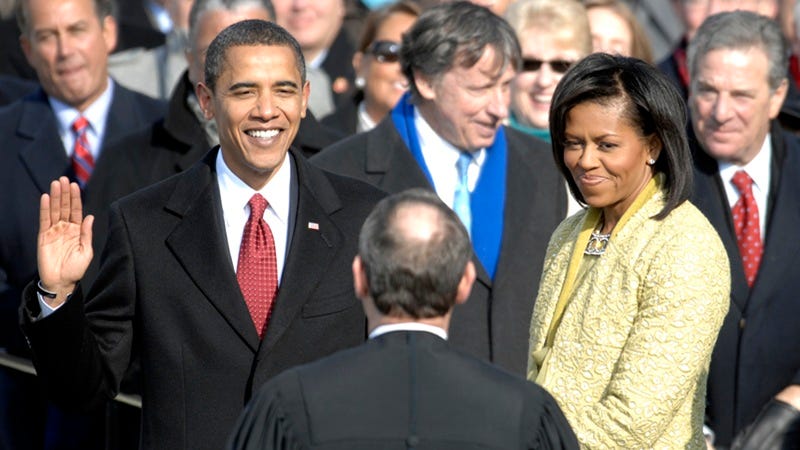
SCENARIO THREE: 2009 - 2012
“We proved that we are still a people capable of doing big things and tackling our biggest challenges.”
– President Obama
January 2009: Hope and Change… Deal with the Great Recession, check. Deal with the Healthcare crisis, check. Deal with Bin Laden, check. Will you lead on the world stage from the front or take a step back? Time to earn that Nobel!
Scenario Victory:
Historical scenarios do not use Legacy Points. At the end of Year 4, your score will be calculated: 15+ points for a Major Victory, 10-14 points for a Minor Victory, 5-9 points for a Minor Defeat, and 4 or less points for a Major Defeat.
There is no auto-win in this scenario, but all other auto-loss endings apply.
The following objectives must be met to achieve Victory Points:
Healthcare: 1 point if you signed your own Healthcare bill. 2 points if it is your own Landmark Healthcare Bill. 3 points if you signed Greater Society Initiative Level 1 “Health, Longevity, and Disease Eradication”, and 4 points if Level 2. Score only the highest that apply, 4 points max.
US State of the Economy: 7: 3 Points; 6: 1 Point; 5: 0 Point; 4: -1 Point; 3: -3 Points.
LDI: 0: 2 Points; 1: 0 Point; 2: -2 Points; 3: -4 Points.
“Russian Reset”: -2 Points If there is a Russian Base in any world region. Otherwise, 2 Points for US Relations with Russia at Relationship Level 4/5 and no more than 1 Russian Influence in the Eurozone and Eastern Europe (if either of these regions has more than one Russian Influence you do not score these points).
“Pivot to Asia”: -2 Points if there is a Chinese Base in any region. Otherwise, 1 Point for all of ROK, Japan, and Australia “Close” or “Very Close” while US Relations with China at Relationship Level 3 or higher and there is no more than 1 Chinese Influence in the Pacific. Additionally, 1 Point for a successful Trade Agreement in the Asia & Pacific.
Public Approval: 62% or higher: 2 Points; 52-60: 1 Point; 42-50: 0 Point; 32-40: -1 Point; 30 or less: -2 Points.
Reelection: Failure to be re-elected is an auto-loss.
World Opinion of US Track: 7/8: 2 Points; 6: 1 Point; 3: -1 Point; 2: -2 Points.
Scenario Special Rules:
Starting Goodwill: two UN Goodwill markers are drawn at random.
Russia: during End of Turn Clean Up & Consequences in Years 1 and 2 no Trending Anti-US counter is placed on Russia’s US Relations Track.
China: during End of Turn Clean Up & Consequences no Trending Anti-US counter is placed on China’s US Relations Track.
Arab Spring:
During the END ROUND of YEAR 2, PRIOR to the END OF TURN & CONSEQUENCES conduct a Stability check for the Middle East.
If fail, refer to Card #92: Add the Lvl 1 Terror Group (as noted on the card), then +1 DRM per Unstable State in region on the card’s d10 roll.
Conduct the same procedure for Africa, substituting Middle East results for Africa.
Product Vision
Since we began developing Mr. President, our goal has been to build a faithful digital port of the board game. I’ve come to see, as does everyone on the team, that this isn’t enough. If you only want a digital port, Vassal and Tabletop Simulator already exist.
Talking with this community has made it clear that the product vision for Mr. President needs to rest on three ideas:
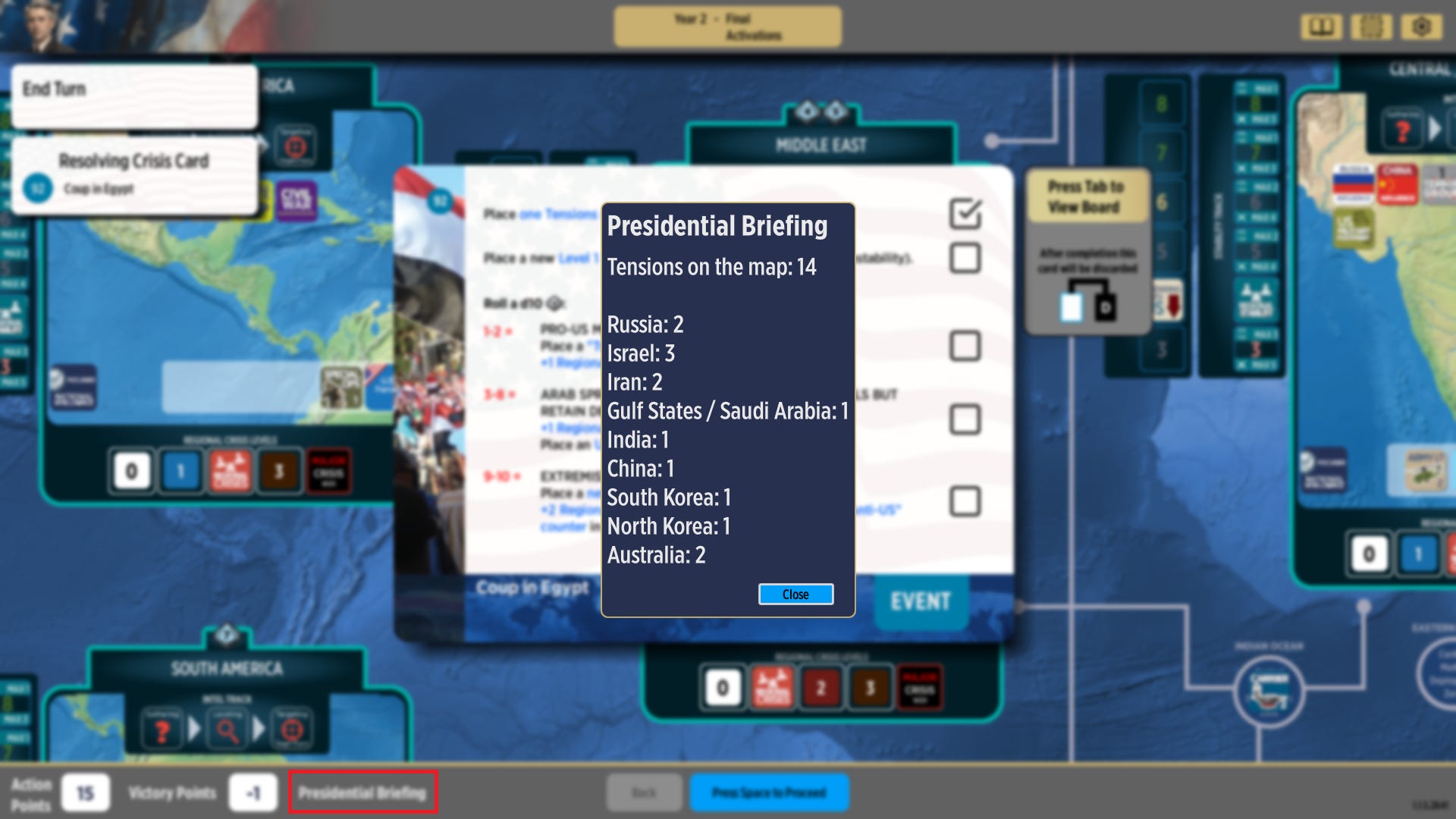
No human bookkeeping. Software is simply better at tracking things like tension counters than people are, and there’s a whole category of low-hanging fruit here for us to tackle. This is the thinking behind the new Presidential Briefing feature.
Explain why things happen. Players often ask why a particular event happened, and the answer shouldn’t be a mystery. The rulebooks are thorough, but you need to be a seasoned player to make sense of them. We can’t answer every question a player might have, and this is a big undertaking that we’ll tackle in stages. It’s the inspiration for upcoming features like Cabinet Advice. When you hover over a member of your cabinet, they’ll suggest their top priorities, so you can see what the Secretary of Defense, the Secretary of State, and the others think you should focus on. We plan to start on this once all the scenarios are complete.
Reimagine the UI/UX. Presidential Briefing and Cabinet Advice don’t change the interface all that much, but the biggest opportunity is in how the whole game looks and feels. A digital version shouldn’t just mirror the tabletop layout. It should be designed around how people actually play on a screen. That starts with the first-time player experience: a new player should be able to sit down, learn the basics as they go, and understand what’s happening and why without needing to read the rulebook first. From there, we want to look at how information is organized throughout the game, so the most important things are always easy to find and nothing critical is buried in a menu.
Presidential Briefing
We shipped v1 of Presidential Briefing, you access it by clicking the new Presidential Briefing button to the right of the Victory Points tracker. In v1, you’ll only be able to see Tension counters, but we plan on adding Rogue States and other things that can be tracked. Apologies for the simple UI for now and if you have ideas of what should be tracked in this menu, tell us in the forums or in Discord.
Game Saves
Summary
Part of the reason we were hesitant to get into historical scenarios is because we just expanded not only the bug risk by each scenario times three difficulties, but also game saves. But we ripped off the band-aid, so let’s talk about how saved games work in Mr. President and where we’re going with them.
Saving records the whole state of your game (every track, token, card deck, and the game’s dice sequence) so you can continue exactly where you left off.
A saved game keeps playing the way it was when you saved it. If we later fix a bug or a text mistake, an older save may not receive the fix.
Because the game changes between updates, keep your important saves backed up, and expect that after a big update a very old save may not load.
We’re working on making saves safer and clearer. Here’s how and why.
How saving works today
What a save contains. When you save, the game writes down the full state of the game: every counter on the map, every track, the Congress and Cabinet, cards in each deck (including their order), wars, scandals, your position in the turn, and the game’s random-number state.
Slots and autosave. You can keep several saves, each with a name, the scenario, the year, and the date. The game also keeps one Autosave slot, which is overwritten each time it saves.
Loading. Loading restores everything above and puts you back in the game.
Undo. Undo is not part of a save. After loading, you can undo only what you do after the load; you can’t step back to before you saved.
Scenarios. Saves work the same way in the Core Sandbox and the historical scenarios. A save remembers which scenario and difficulty you were playing.
What you should know
Old saves keep old values. A save stores the settings of game objects as they were at the time. If an update corrects a table result, a rule, or a typo, a game saved before the update may keep the old behavior. A new game gets the fix.
Big updates can break old saves. If we rename or rework parts of the game, saves from before that change might not load correctly. Today the game doesn’t always tell you clearly when this happens; we’re improving that.
A single autosave. The autosave slot is overwritten each time, so it’s best not to rely on it alone for a game you care about.
What you can do now
Keep manual saves at the start of each turn, and keep a few older ones rather than overwriting one slot.
Before updating the game or changing language (future localization plans...), copy your save folder somewhere safe.
If a save loads strangely (missing pieces, odd numbers), don’t keep playing it. Tell us the game version and which save it was.
Starting a new game after a major update is the safest way to get all fixes.
Where we’re going
We’ve looked at several ways to make saves more reliable. Here are the options and what each means for you.
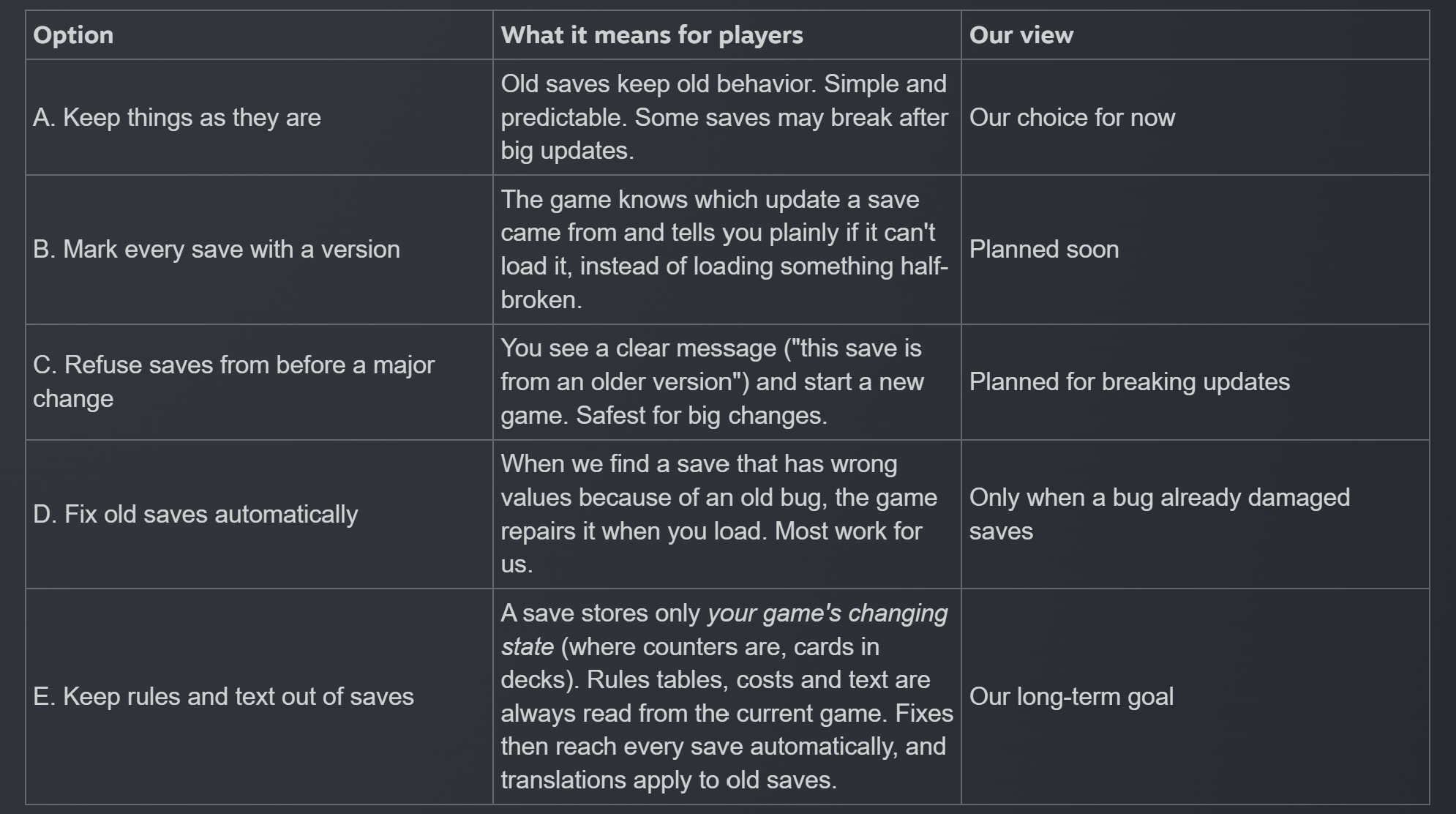
Why option E is the goal. Today the save also stores fixed information about the game’s objects, so a save can hold on to old versions of things that we later correct. Moving to E means saves would hold only the situation you’re in, and the current game would supply the rules and text. It’s a bigger change, so we’ll do it step by step, and we’ll write new features that way from the start.
What stays the same either way. Undo history will not be saved. Your dice sequence will keep being saved. We’ll keep testing saves with every update, including saves from earlier versions, in every scenario.
Bug Fixes
For all historical scenarios:
The game now ends on the Victory Points screen after Year 4. The Legacy Points screens and the Core Sandbox ending no longer appear (this used to happen when you fail re-election).
The failed re-election screen no longer says “-5 Legacy Points”. The Sandbox keeps its original text
The End of Turn cleanup hides Trending Anti-US lines the scenario has blocked. If both are blocked, the cleanup card is skipped.
Easier no longer adds the extra Rogue State in Central/South Asia or the extra attacker modifier on War #1. Easier does still differ from Normal in the Level 1 Terror pool, the Terrorism deck and the Tension pool.